How Crismo captures your business for AI
You've identified where AI can create value. Now your processes, value chains, and decision logic need to become structured context that AI agents can actually consume.
The shift
From diagrams to machine-readable business models
Most companies document processes in slides and flowcharts. Useful for humans-invisible to AI. Crismo changes that.
The Problem
AI doesn't know your business
AI tools work from prompts and guesswork-not shared operational knowledge. Every automation project starts with weeks of rediscovery.
The Shift
Structured, machine-readable models
Crismo captures your processes as semantic data that machines can parse-not just visual diagrams that only humans can read.
The Result
AI reads your business directly
One model feeds every tool. When processes change, AI behavior updates automatically. No retraining, no prompt surgery.
Three steps from knowledge to AI-ready context
Capture what you know. Connect it into one governed model. Feed consistent context to every AI tool.
Capture
Gather operational knowledge
- Interviews
- Diagrams
- Value chains
- Decision rules
Connect
Link into governed truth
- Single source of truth
- Decision relationships
- Hierarchical context
- Governed definitions
Propagate
Feed consistent context
- Export formats
- API access
- Live sync
- Consistent across tools
Step 1
Capture everything that makes your business work
Not just workflows-the full operational context AI needs to make good decisions.
- Process diagrams
- Workflows, swim lanes, task sequences, handoff points between teams
- Value chain maps
- How value flows from input to customer-where margin is created and lost
- Decision rules
- Approval logic, routing criteria, thresholds, exception handling
- Actor definitions
- Who does what, responsibilities, escalation paths, role boundaries
- System touchpoints
- Which tools are used where, integration points, data flows
Step 2
From conversations to machine-readable models
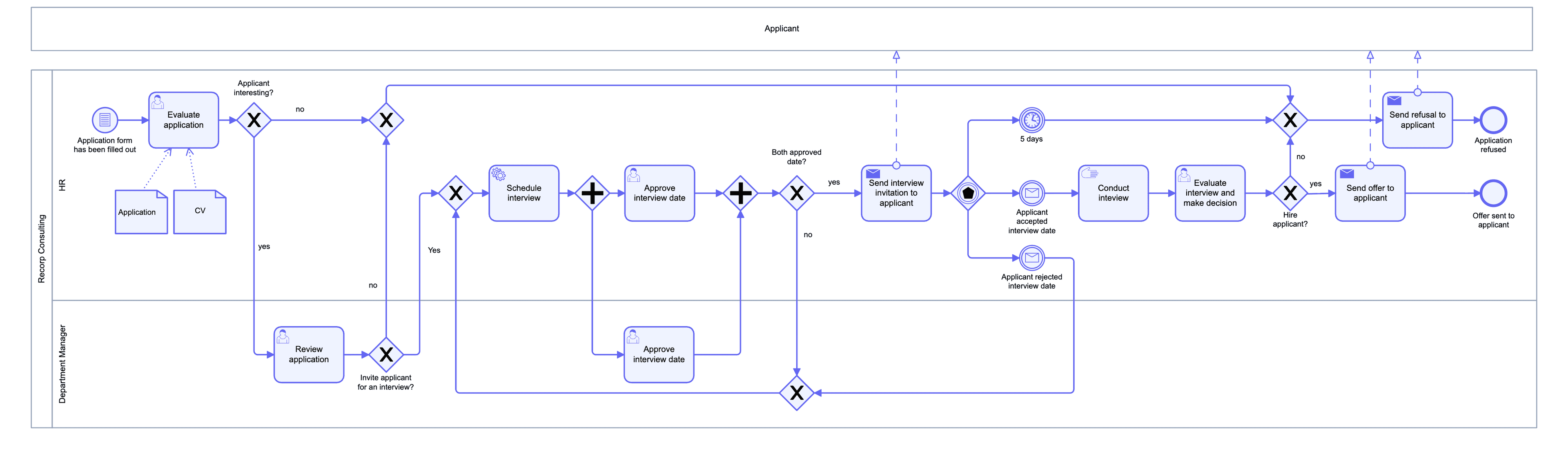
Crismo doesn't just draw diagrams-it builds structured, linked knowledge that machines can parse.
- BPMN 2.0 standard
- Industry-standard format that automation platforms already understand
- Semantic relationships
- Processes link to value chains, decisions link to actors, everything connects
- Hierarchical linking
- Strategic goals → operational processes → task-level steps - all traceable
- Structured extraction
- Interviews become typed elements: actors, tasks, gateways, systems - not just text
<?xml version="1.0" encoding="UTF-8"?>
<definitions xmlns="http://www.omg.org/spec/BPMN/20100524/MODEL">
  <process id="sid-A9A9054C" name="Hiring Process">
    <laneSet>
      <lane id="sid-E63242D1" name="HR">
        <flowNodeRef>Task_ReviewApplication</flowNodeRef>
        <flowNodeRef>Task_SendInvitation</flowNodeRef>
        <flowNodeRef>Task_PrepareContract</flowNodeRef>
      </lane>
      <lane id="sid-ED60A31F" name="Department Manager">
        <flowNodeRef>Task_ConductInterview</flowNodeRef>
      </lane>
    </laneSet>
    <startEvent id="sid-CA4B6B4D"
        name="Application form filled out">
      <outgoing>Flow_ToReview</outgoing>
    </startEvent>
    <userTask id="Task_ReviewApplication"
        name="Review application">
      <incoming>Flow_ToReview</incoming>
      <outgoing>Flow_ToGateway</outgoing>
    </userTask>
    <exclusiveGateway id="Gateway_Qualified"
        name="Applicant qualified?"/>
    <sendTask id="Task_SendInvitation"
        name="Send interview invitation"/>
  </process>
</definitions>Same process. Visual for alignment, structured for automation. Drag to explore →
Step 3
One model, every agent
Your process knowledge becomes a shared foundation for all AI tools-not fragmented prompt instructions.
- BPMN export
- Standard XML that automation platforms (Camunda, n8n, etc.) read directly
- API access
- Query process definitions, decision rules, actor mappings programmatically
- Live sync
- Process updates propagate automatically-no manual re-prompting of each tool
- Explainability
- Every AI recommendation traces back to a documented process step
Why this matters
Update the model, not the agents
Traditional approach
Process changes
A step gets added, a rule evolves
Update each automation manually
Find every tool that references this
Hope nothing breaks
Missed one? You'll find out later
Repeat for every tool
Same work, forever
Crismo approach
Process changes
Same trigger as before
Update the model once
Single source of truth
AI agents read updated definitions
No code changes required
Behavior adapts automatically
Done. Move on.
Built on standards
No proprietary lock-in. Your process knowledge stays portable.
- BPMN 2.0
- Process modeling interoperability
- JSON-LD
- Semantic web-ready knowledge graphs
- REST API
- Programmatic access for integrations
- XML export
- Standard format for workflow engines
Ready to make your business AI-ready?
We're working with early adopters to implement this approach. Let's discuss how it could work for your organization.