Most BPMN diagrams nail the mechanics while customer journey maps capture the moments. Kept apart, neither tells the full story—and your customers feel the cracks. This post shows how to stitch operations and experiences into one seamless flow.
Why Map Operations to Customer Experience?
Ever tried calling your internet provider to cancel a subscription? You’re bounced between departments, asked to repeat your details five times, and left on hold—only to be told you need to send a fax (yes, really). It’s the kind of maddening journey we’ve all endured.
Behind the scenes, everything looks perfect. The company’s processes are neatly diagrammed, automated, and “optimized.” So why does the customer journey still feel so clunky?
Here’s the kicker: great processes don’t automatically equal great experiences. If we don’t map BPMN flows to actual customer journeys, we risk optimizing for internal logic while customers get stuck.
Think of BPMN as the factory floor; the customer journey is the storefront. You can optimize production endlessly, but if the shop feels cold and confusing, people still walk out. Too often, organizations design journeys to match their systems—not how customers want to engage. The result? Frustration, churn, and missed opportunities.
The Journey-First Framework: 5 Steps
So how do you flip the script? Start with the customer journey, then let your BPMN flows follow. Here’s a simple framework:
-
Plot the ideal journey
Don’t let current operations limit your vision. Ask: What would this feel like if anything were possible? -
Identify critical touchpoints
Find the emotional highs and lows where processes either delight or frustrate users. -
Bring in your BPMN flows
Compare operational steps with customer expectations. Spot the gaps, clumsy handoffs, and redundancies. -
Reshape processes around the journey
Adapt internal workflows so they flex around customer needs instead of forcing customers to adapt. This is where the heavy lifting happens. -
Run customer simulations
Walk through the end-to-end experience across channels. Adjust until you hit the sweet spot where efficiency meets delight.
Mini-Case: Designing Invitations at Crismo
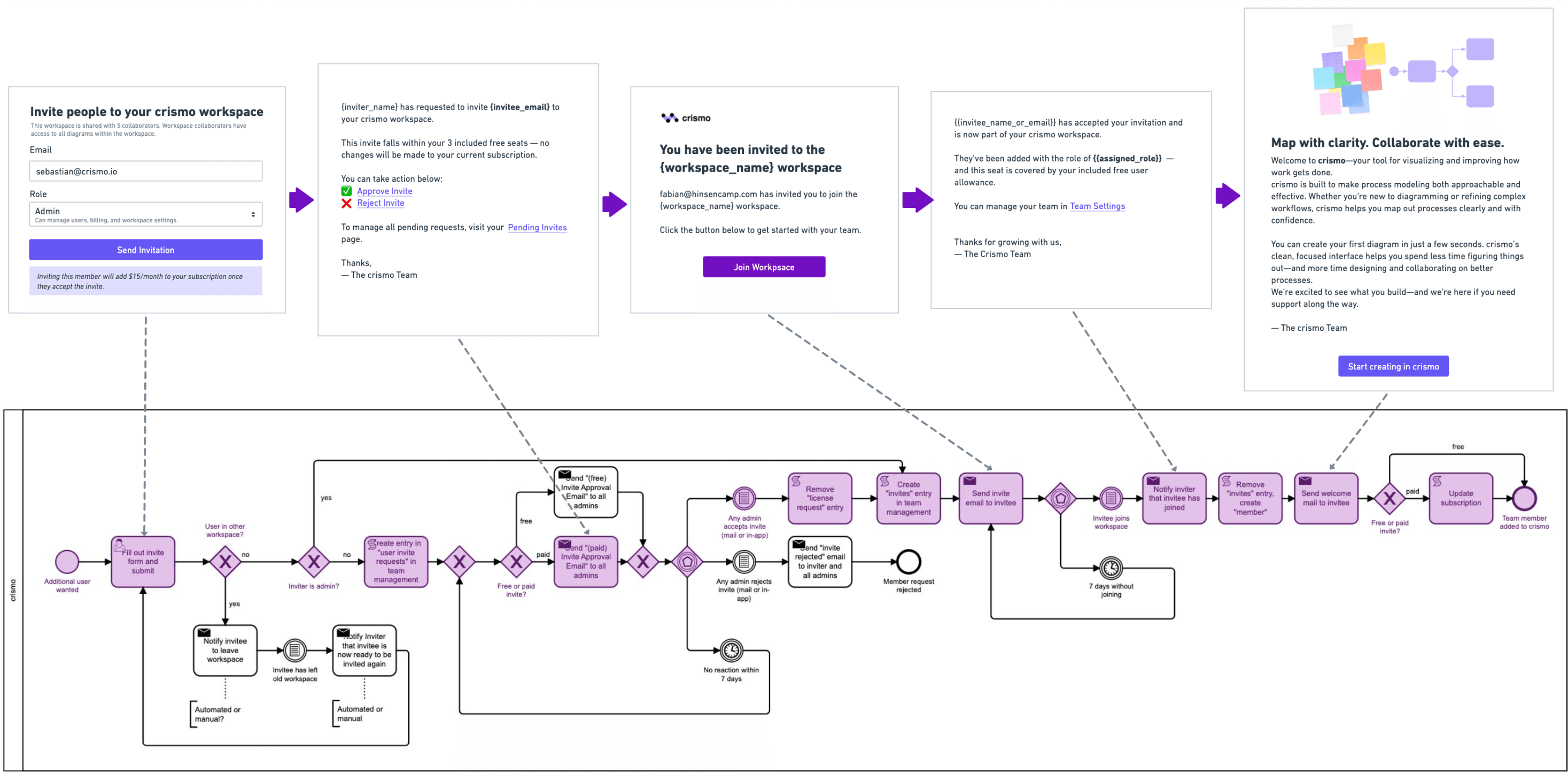
When we built the team invitation flow in crismo, we started where it matters most: the user’s experience.
We mapped what it should feel like to send or receive an invite. Where might someone hesitate, get confused, or even abandon the process?
We explored edge cases—like expired invites or existing accounts—and designed the experience first. Only then did we create the BPMN diagram powering the workflow.
The result: a back-end process that not only works for us internally but also creates a smooth, intuitive experience for real users.
Quick Wins: 4 CX-Driven Process Hacks
- Map before you model – Sketch the journey first.
- Zoom in on friction – Use NPS, feedback, or frontline insights to find pain points.
- Speak human – Use clear, simple words in customer-facing steps.
- Design for exceptions – Customers rarely follow your perfect flow; build for detours.
Free Resource: CX to BPMN Mapping Template
Want a shortcut? Grab our CX-to-BPMN mapping template—a simple artefact that shows how customer experience elements align with BPMN shapes. Perfect for bridging user journeys and operational flows.
👉 Download CX Meets BPMN (PDF)
Final Thought
You can’t afford bad user experiences. But you also can’t afford inefficient operations. The real win comes when you merge BPMN with customer journeys—so processes don’t trap customers in loops but feel like magic instead.
Try Crismo
Model your process. Find opportunities to improve it.
Map your process in BPMN 2.0, understand how it works, and uncover opportunities to optimise it.