Most organisations no longer ask whether AI can help them. The harder question is where to start. With dozens or hundreds of processes in the landscape, it is tempting to pick whatever is loudest: the pilot a vendor pitched, the team that asked first, the use case that made the news.
A better starting point is the process landscape you already have. If your processes are modelled, you already know what the organisation does, who does it and how well it is understood. That is exactly the information you need to choose AI initiatives that are both valuable and realistic.
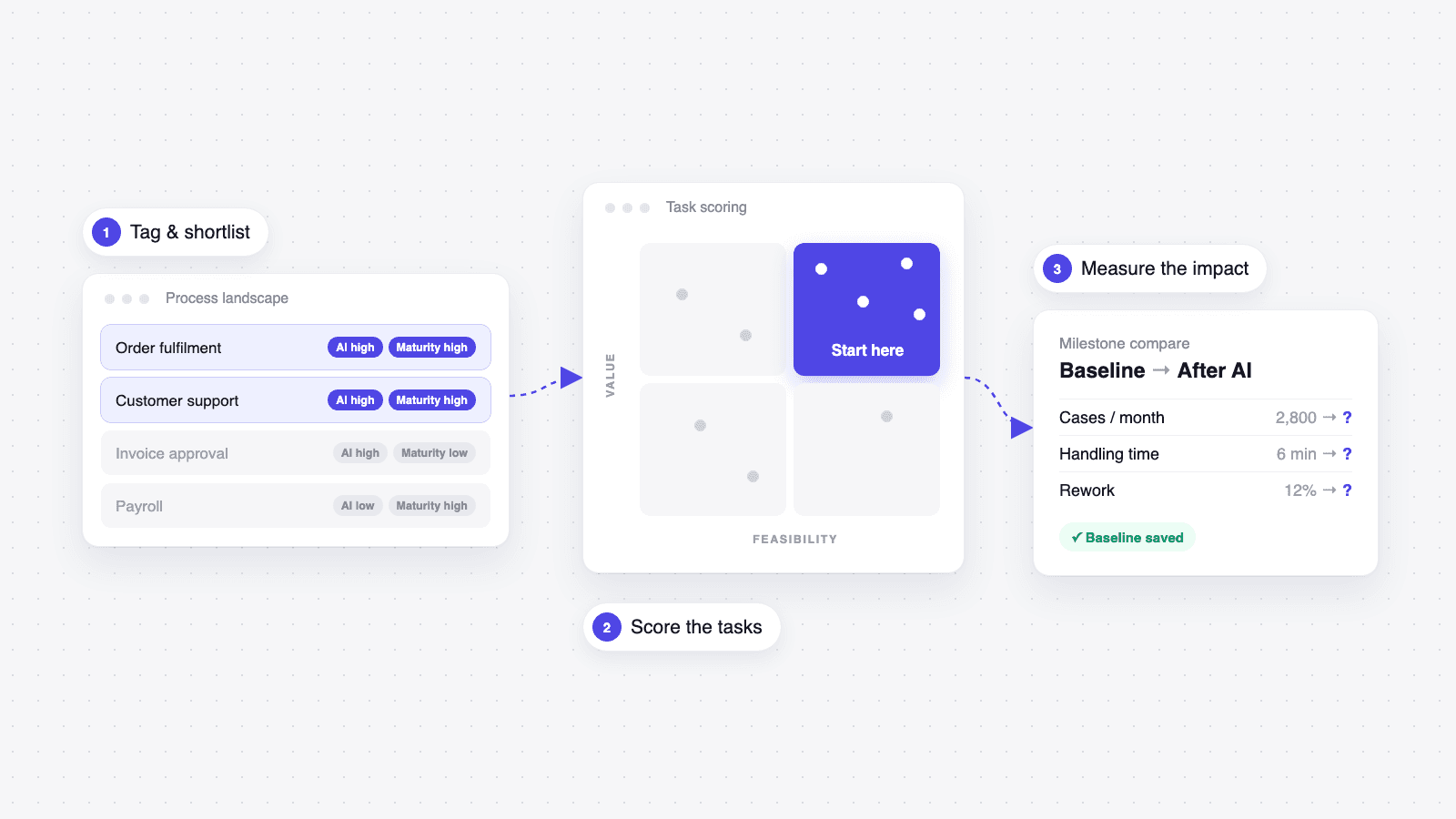
Here is a simple three-step approach: shortlist processes, score the tasks inside them, then measure whether the change actually worked.
Step 1: Tag the processes, then shortlist
Start at the level of whole processes. Rate each one on two dimensions, using high, medium or low:
- AI potential: how much could AI help here? Think repetitive work, lots of unstructured input such as emails, documents and tickets, classification, drafting or decision support.
- Process maturity: how well is the process defined and managed? Is it documented, does it have a clear owner, does it run consistently?
Then start with the processes that score high on both.
| Process | AI potential | Maturity | Verdict |
|---|---|---|---|
| Order fulfilment | High | High | Shortlist |
| Customer support | High | High | Shortlist |
| Invoice approval | High | Low | Groundwork first |
| Payroll | Low | High | Not an AI priority |
Why does maturity matter so much? Because AI amplifies whatever process it is applied to. Put it on top of a process nobody fully understands and you automate the confusion. Invoice approval in the example has high AI potential, but low maturity means it needs some groundwork first: clarify the steps, the rules and the owner, then come back to it.
The goal of this step is not a perfect ranking. It is a short, defensible list of processes worth a closer look.
Step 2: Score the tasks, start in the top corner
AI is rarely applied to a process as a whole. It is applied to specific tasks within a process: classifying an incoming request, drafting a reply, checking a document, extracting data from a form. If you want a systematic way to spot those tasks on a diagram, your process model is an AI opportunity map.
For each shortlisted process, look inside and score its tasks on two more dimensions:
- Value potential: how much value could AI create on this task? Time saved, errors avoided, faster cycle times, a better customer experience.
- Feasibility: how easy would it be to implement? Is the data available, is the task well defined, are there tools that can already do it?
Plot the tasks on a simple two-by-two grid, value on one axis and feasibility on the other. Start with the top corner: the tasks that score high on both. These become your first AI initiatives. They deliver visible results quickly and build confidence for the harder cases.
If you need more nuance, add criteria such as risk (what happens if the AI gets it wrong?) or data availability. But resist building an elaborate scoring model before you have run a single initiative. Two dimensions are usually enough to get moving.
Step 3: Keep the baseline, measure the impact
This is the step most teams skip, and it is the one that decides whether AI earns its budget next year.
Before making changes, save how the process works today: the current version of the model together with its key numbers. For example:
- Volume: 2,800 cases per month
- Handling time: 6 minutes per case
- Rework rate: 12%
Once AI is live, measure the same task with the same metrics and compare the new results with the original.
Without a baseline, every AI project ends up "successful" because nobody can prove otherwise. With one, you can see whether the change actually delivered value, rather than just assuming it did. You also get a clear story for stakeholders, and a solid reason to scale what works and stop what does not.
Putting it together
The three steps form a simple funnel:
- Processes. Tag every process for AI potential and maturity, and shortlist the ones that score high on both.
- Tasks. Score the tasks inside those processes for value and feasibility, and start in the top corner.
- Impact. Save a baseline before you change anything, and compare before and after once AI is live.
None of this needs a large transformation programme. It needs a reasonably complete view of your processes, a few consistent ratings and the discipline to measure.
In Crismo the whole flow lives in one place. Model your processes, tag them with AI potential and maturity, let AI draft the task scores for you to review, filter the shortlist, and save a milestone before you change anything so you can compare before and after.
Try Crismo
Model your process. Find opportunities to improve it.
Map your process in BPMN 2.0, understand how it works, and uncover opportunities to optimise it.